Carbon Nanotubes (CNTs) | Vibepedia
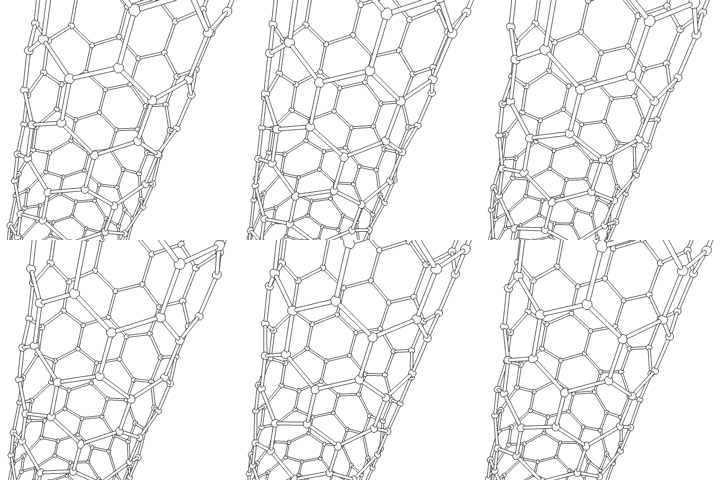
Carbon nanotubes (CNTs) are cylindrical molecules made of rolled-up sheets of single-layer carbon atoms (graphene). Discovered in 1991 by Sumio Iijima at NEC…
Contents
- 🔬 What Are Carbon Nanotubes?
- 📏 Types and Structures
- 💡 Key Properties & Applications
- 🏭 Manufacturing & Sourcing
- 💰 Cost & Availability
- ⚖️ Advantages vs. Disadvantages
- 🚀 Future Outlook & Research
- 🤔 Common Misconceptions
- 🤝 Who Uses CNTs?
- ⚠️ Safety & Handling
- 📚 Further Exploration
- 📞 Getting Started with CNTs
- Frequently Asked Questions
- Related Topics
Overview
Carbon nanotubes (CNTs) are cylindrical molecules made of rolled-up sheets of single-layer carbon atoms (graphene). Discovered in 1991 by Sumio Iijima at NEC, these structures boast incredible tensile strength, electrical conductivity, and thermal properties, making them a tantalizing prospect for everything from electronics and energy storage to aerospace and medicine. However, their widespread adoption has been hampered by challenges in mass production, cost, and understanding their long-term health and environmental impacts. Despite these hurdles, research continues to unlock their potential, with ongoing debates about their true Vibe Score and the ethical considerations surrounding their deployment.
🔬 What Are Carbon Nanotubes?
Carbon Nanotubes (CNTs) are not just another material; they represent a fundamental shift in how we engineer at the atomic level. Imagine a single sheet of graphene – that 2D marvel of carbon atoms – rolled into a seamless cylinder. That's the essence of a CNT, a structure so small its diameter is measured in nanometres, a billionth of a meter. This unique architecture bestows upon them extraordinary mechanical, electrical, and thermal properties, making them a cornerstone of nanotechnology research and development. Their discovery in the early 1990s, notably by Sumio Iijima in 1991, opened a Pandora's Box of possibilities for advanced materials.
📏 Types and Structures
CNTs aren't monolithic; they come in distinct flavors. The simplest are SWCNTs, boasting diameters as narrow as 0.5 nanometres. Think of them as perfect, hollow cylinders derived from a single layer of graphene. Then there are MWCNTs, which are essentially concentric tubes of graphene nested within each other, like a set of Russian dolls. The number of walls and their arrangement significantly influence the overall properties, leading to a diverse range of materials suitable for specific advanced applications.
💡 Key Properties & Applications
The allure of CNTs lies in their astonishing properties. Mechanically, they are among the strongest and stiffest materials known, with tensile strengths exceeding steel by orders of magnitude. Electrically, they can be metallic or semiconducting, depending on their chirality (the way the graphene sheet is rolled), enabling applications in advanced electronics and conductive polymers. Thermally, they are excellent heat conductors. These traits translate into potential uses in everything from lighter, stronger composites for aerospace to next-generation batteries and biosensors.
🏭 Manufacturing & Sourcing
Producing CNTs is a sophisticated process, typically involving methods like arc discharge, laser ablation, or chemical vapor deposition (CVD). Each method has its strengths and weaknesses regarding purity, yield, and cost. CVD is currently the most scalable and widely used for industrial production, allowing for control over CNT diameter, length, and chirality to some extent. However, achieving high purity and specific structural characteristics remains a significant challenge for manufacturers like Nano-$C_60$ and Cheap Tubes.
💰 Cost & Availability
The cost of CNTs can vary dramatically, from tens to thousands of dollars per gram, depending on the type (SWCNT vs. MWCNT), purity, quantity, and specific characteristics required. SWCNTs, especially those with high purity and controlled chirality, are generally more expensive than MWCNTs due to the complexity of their synthesis and purification. While bulk MWCNTs are becoming more accessible for industrial applications, high-performance SWCNTs for cutting-edge research or specialized electronics still command a premium, impacting their widespread adoption in consumer products.
⚖️ Advantages vs. Disadvantages
CNTs offer unparalleled strength-to-weight ratios, exceptional electrical conductivity, and superior thermal management capabilities, making them ideal for high-performance materials. However, challenges persist. Their production can be energy-intensive, and achieving consistent quality and purity across batches is difficult. Furthermore, concerns about potential health and environmental impacts necessitate careful handling and regulatory oversight, a point often debated in nanomaterial safety discussions.
🚀 Future Outlook & Research
The future of CNTs is bright, fueled by ongoing research into more efficient synthesis methods, precise control over their properties, and novel applications. Scientists are exploring their use in quantum computing, advanced drug delivery systems, and even as components in artificial muscles. The drive towards lighter, stronger, and more conductive materials across industries like automotive, aerospace, and energy ensures that CNT research will remain at the forefront of materials science innovation.
🤔 Common Misconceptions
A common misconception is that all CNTs are identical. In reality, their properties are highly dependent on their diameter, length, number of walls, and crucially, their chirality – the specific arrangement of carbon atoms that dictates whether they behave as a metal or a semiconductor. Another myth is that they are inherently toxic; while caution is advised due to their nanoscale nature, extensive research is ongoing to fully understand their biological interactions and establish safe usage protocols, a topic central to nanotoxicology.
🤝 Who Uses CNTs?
CNTs are primarily utilized by researchers in academic institutions and corporate R&D departments pushing the boundaries of science and engineering. Industries such as aerospace and defense employ them for lightweight structural components and conductive coatings. The electronics sector investigates their use in transistors, sensors, and transparent conductive films. The energy sector explores their potential in advanced batteries, supercapacitors, and fuel cells, while the biomedical field looks at them for diagnostics and therapeutics.
⚠️ Safety & Handling
Due to their nanoscale dimensions, CNTs can become airborne and pose potential respiratory risks if inhaled. It is crucial to handle them in well-ventilated areas, preferably within a fume hood, and to use appropriate personal protective equipment (PPE), including gloves, lab coats, and respiratory protection. Proper containment and disposal procedures are essential to mitigate any potential environmental contamination and ensure worker safety, aligning with occupational safety standards.
📚 Further Exploration
For those looking to understand the deeper science, exploring the concept of graphene allotropes provides context. Investigating nanomaterial synthesis techniques reveals the engineering challenges. Understanding quantum confinement effects in nanomaterials can illuminate their unique electronic behavior. Finally, delving into nanomaterial safety guidelines is critical for anyone considering practical application.
📞 Getting Started with CNTs
To begin working with CNTs, the first step is to identify your specific application and the required properties. This will guide your choice between SWCNTs and MWCNTs, and the necessary purity levels. Many specialized suppliers, such as Sigma-Aldrich and ACS Material, offer a range of CNT products. For larger industrial quantities, direct contact with manufacturers is often necessary. Always consult material safety data sheets (MSDS) before handling and ensure you have the appropriate safety equipment and laboratory facilities.
Key Facts
- Year
- 1991
- Origin
- Sumio Iijima, NEC Corporation
- Category
- Advanced Materials
- Type
- Material Science
Frequently Asked Questions
Are carbon nanotubes dangerous?
The potential health effects of CNTs are an active area of research. Like other fine particulates, inhalation can be a concern, and proper safety precautions, including ventilation and respiratory protection, are essential. Regulatory bodies are still developing comprehensive guidelines, but current recommendations emphasize minimizing exposure through engineering controls and personal protective equipment, as detailed in nanomaterial safety guidelines.
What's the difference between SWCNTs and MWCNTs?
SWCNTs are single-walled tubes with diameters around 0.5-2 nm, offering highly specific electronic and mechanical properties. MWCNTs are composed of multiple concentric tubes, making them generally more robust and less expensive, though with potentially less precisely tunable properties. The choice depends heavily on the intended advanced applications.
How are carbon nanotubes made?
The primary methods for producing CNTs include arc discharge, laser ablation, and chemical vapor deposition (CVD). CVD is the most scalable for industrial production, allowing for some control over CNT characteristics. Each method has trade-offs in terms of purity, yield, and cost, impacting the final cost and availability of the material.
Can carbon nanotubes be used in everyday products?
While CNTs are finding their way into some high-performance applications, widespread use in everyday consumer products is still limited by cost, scalability, and safety considerations. However, they are increasingly incorporated into specialized items like conductive polymers for antistatic coatings, advanced sports equipment, and certain electronic components, with potential for broader adoption as technology matures.
What makes carbon nanotubes so strong?
The exceptional strength of CNTs stems from the strong covalent bonds between carbon atoms in their hexagonal lattice structure, similar to graphene. When rolled into a tube, this structure creates a material with an incredibly high tensile strength and stiffness, making them one of the strongest and stiffest materials known, far surpassing conventional materials like steel.
Are carbon nanotubes expensive?
The price of CNTs varies significantly. High-purity, specific-chirality SWCNTs can cost thousands of dollars per gram, while bulk MWCNTs are much more affordable, often in the range of tens to hundreds of dollars per kilogram for industrial grades. The cost and availability are directly tied to the synthesis method, purity, and scale of production.