Chronobiology | Vibepedia
Chronobiology is the scientific discipline dedicated to understanding the biological rhythms that govern life, from the daily cycles of sleep and wakefulness…
Contents
Overview
The formal study of biological rhythms, chronobiology, traces its roots to observations made centuries ago, though the term itself was coined in the mid-20th century. Early pioneers like [[jean-jacques-d'ortous-de-mairan|Jean-Jacques d'Ortous de Mairan]] in the 1720s observed the daily leaf movements of a mimosa plant even in constant darkness, suggesting an internal mechanism. Later, [[august-forel|August Forel]] documented circadian rhythms in ants in the late 19th century. The field gained significant momentum with the work of [[franz-hellbrügge|Franz Hellbrügge]] and [[jürgen-aschoff|Jürgen Aschoff]] in the 1950s and 60s, who systematically investigated circadian rhythms across species and environments, establishing key principles. The discovery of the 'clock genes' like [[period-gene|Period]] and [[timeless-gene|Timeless]] in fruit flies provided crucial molecular insights. This molecular revolution transformed chronobiology from a descriptive science to one with deep mechanistic understanding.
⚙️ How It Works
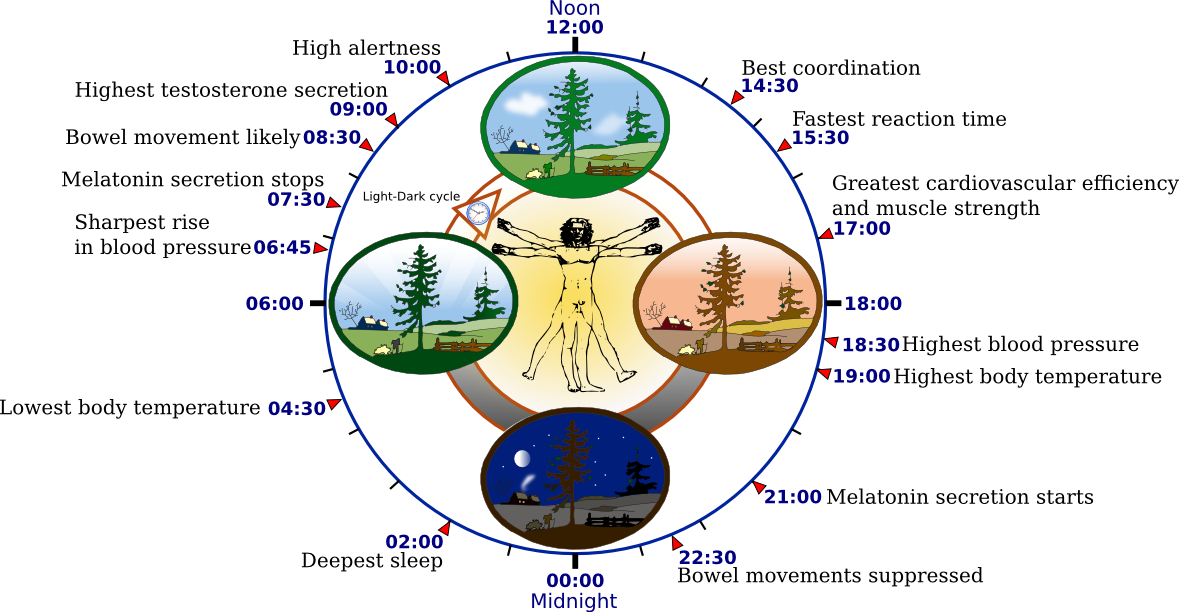
At its core, chronobiology investigates biological clocks, primarily the [[circadian-rhythm|circadian clock]], which operates on a roughly 24-hour cycle. This internal timekeeper is not a single organ but a complex network of molecular oscillators found in nearly every cell of an organism. In mammals, the master clock resides in the [[suprachiasmatic-nucleus|suprachiasmatic nucleus (SCN)]] of the hypothalamus, which receives light cues directly from the eyes. These cues synchronize the SCN to the external day-night cycle. The SCN then sends signals to peripheral clocks in organs like the liver, heart, and muscles, coordinating their functions. The molecular machinery involves a feedback loop of 'clock genes' (e.g., [[bmal1-gene|BMAL1]], [[clock-gene|CLOCK]], [[per-gene|PER]], [[cry-gene|CRY]]) that activate and repress each other over approximately 24 hours, driving rhythmic gene expression and protein production. This intricate system dictates patterns of sleep, hormone secretion, body temperature, and metabolism.
📊 Key Facts & Numbers
The human body operates on a remarkable temporal precision. The human circadian system can be reset by as little as 15 minutes of bright light exposure. [[Shift work|Shift workers]], estimated to be around 15-25% of the workforce in industrialized nations, experience a significant disruption of their circadian rhythms, leading to a higher incidence of cardiovascular disease, metabolic syndrome, and certain cancers. The average human [[sleep-cycle|sleep cycle]] lasts about 90 minutes, with distinct stages of [[rem-sleep|REM]] and non-REM sleep. Disruptions to the circadian rhythm, such as those experienced by [[jet-lag|jet lag]], can impair cognitive performance. The economic cost of sleep deprivation and circadian disruption is staggering, estimated to be over $100 billion annually in the United States alone due to lost productivity and healthcare expenses.
👥 Key People & Organizations
Several key figures have shaped the field of chronobiology. [[Jürgen Aschoff|Jürgen Aschoff]] was a pivotal figure in establishing the systematic study of circadian rhythms, conducting extensive experiments on human and animal subjects. [[Franz Halberg|Franz Halberg]] championed the idea of studying biological rhythms across all time scales, from milliseconds to years. Organizations like the [[society-for-research-on-biological-rhythms|Society for Research on Biological Rhythms]] and the [[european-biological-rhythms-society|European Biological Rhythms Society]] foster research and collaboration. Major research institutions, including [[brandeis-university|Brandeis University]] and [[rockefeller-university|The Rockefeller University]], host leading chronobiology labs.
🌍 Cultural Impact & Influence
Chronobiology's influence extends far beyond academic circles, permeating our understanding of health, society, and even culture. The widespread adoption of the 24-hour clock and the concept of a 'day job' are societal manifestations of our circadian nature. The recognition of [[shift work disorder]] as a medical condition by the [[international-classification-of-diseases|International Classification of Diseases (ICD)]] highlights its impact on public health. Popular culture has embraced the idea of internal clocks, with books and documentaries exploring topics from sleep hygiene to the effects of artificial light. The field's insights have also informed architectural design, advocating for spaces that better align with natural light cycles. Furthermore, understanding seasonal affective disorder (SAD) and other mood disorders has been profoundly advanced by chronobiological research into photoperiodism.
⚡ Current State & Latest Developments
The current landscape of chronobiology is dynamic, with rapid advancements in understanding the interplay between circadian rhythms and various diseases. Researchers are actively investigating the role of circadian disruption in the development and progression of [[cancer|cancers]], [[diabetes-mellitus|diabetes]], [[cardiovascular-disease|cardiovascular diseases]], and [[neurodegenerative-diseases|neurodegenerative disorders]]. The development of [[circadian-therapeutics|circadian therapeutics]]—drugs designed to align with or correct biological rhythms—is a major focus. Furthermore, the integration of wearable technology and [[big-data-analytics|big data analytics]] is enabling more precise monitoring of individual circadian profiles, paving the way for personalized medicine. The impact of the [[covid-19-pandemic|COVID-19 pandemic]] also spurred new research into how viral infections interact with host circadian rhythms, potentially influencing disease severity and immune response.
🤔 Controversies & Debates
While chronobiology is a well-established science, debates persist regarding the precise extent of circadian influence on all biological processes and the optimal strategies for managing circadian disruption. A significant controversy revolves around the classification of shift work as a [[carcinogen|carcinogen]] by the [[international-agency-for-research-on-cancer|International Agency for Research on Cancer (IARC)]] in 2007 (Group 2A, 'probably carcinogenic to humans'), which some argue requires stronger epidemiological evidence. Another area of contention is the efficacy and long-term safety of [[melatonin-supplements|melatonin supplements]] for sleep and circadian regulation, with varying regulatory oversight across different countries. The precise mechanisms by which peripheral clocks communicate with the master clock and influence systemic physiology are also still areas of active investigation and debate among researchers.
🔮 Future Outlook & Predictions
The future of chronobiology is poised for significant growth, driven by technological advancements and a deepening understanding of its health implications. Personalized chronotherapy, tailored to an individual's unique circadian profile, is expected to become a cornerstone of preventative and therapeutic medicine. Research into the gut [[microbiome|microbiome]] and its rhythmic interactions with host clocks promises new avenues for treating metabolic and immune disorders. The development of novel pharmaceuticals that target specific clock components for conditions like [[insomnia|insomnia]], [[depression|depression]], and [[obesity|obesity]] is anticipated. Furthermore, as humanity increasingly ventures into space, understanding and managing circadian rhythms in altered gravitational and light environments will be crucial for astronaut health and performance, potentially leading to the development of artificial circadian cues for [[space-exploration|space exploration]].
💡 Practical Applications
Chronobiology has direct, practical applications across numerous domains. In medicine, it informs treatment t
Key Facts
- Category
- science
- Type
- topic