Hildebrandslied | Vibepedia
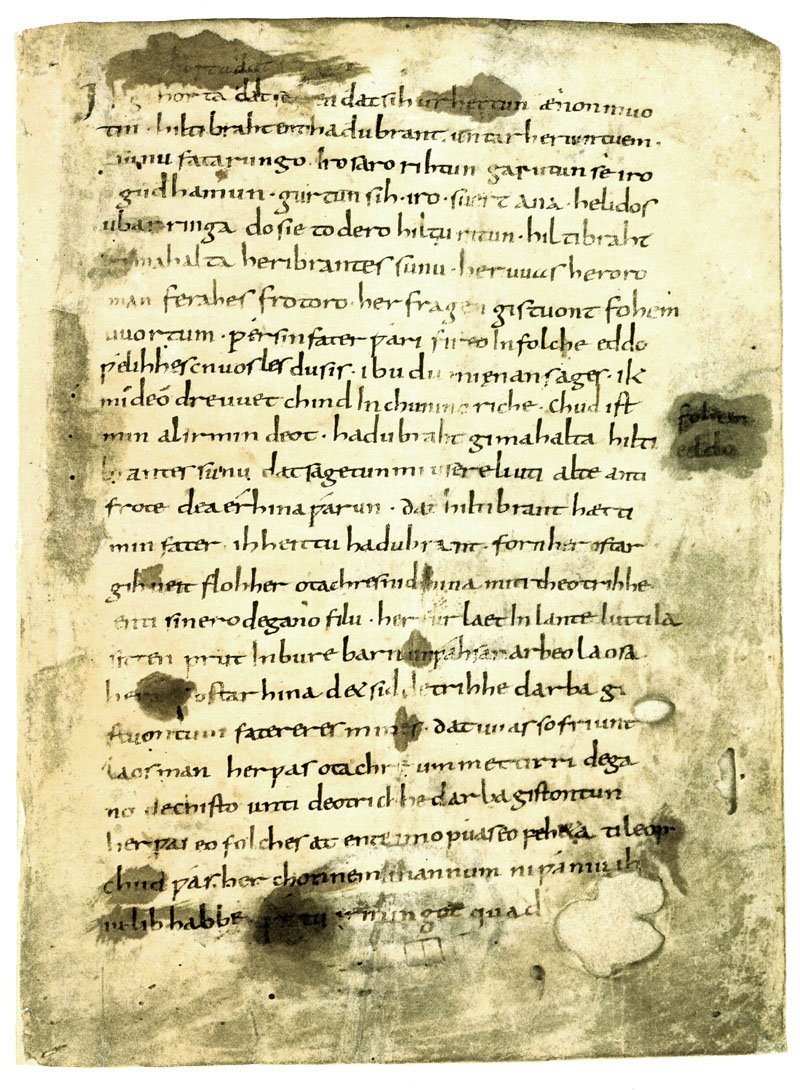
The Hildebrandslied, or 'Lay of Hildebrand,' stands as the singular surviving example of a Germanic heroic lay in Old High German, a linguistic and literary…
Contents
- 🎵 Origins & History
- ⚙️ How It Works
- 📊 Key Facts & Numbers
- 👥 Key People & Organizations
- 🌍 Cultural Impact & Influence
- ⚡ Current State & Latest Developments
- 🤔 Controversies & Debates
- 🔮 Future Outlook & Predictions
- 💡 Practical Applications
- 📚 Related Topics & Deeper Reading
- Frequently Asked Questions
- References
- Related Topics
Overview
The Hildebrandslied's genesis is firmly placed around 830 CE, transcribed by two scribes onto the outer leaves of a religious codex at the renowned Monastery of Fulda in what is now modern Germany. This wasn't an original composition but a painstaking copy from an older, now-lost manuscript, itself a written echo of a vibrant oral tradition. The narrative's core, however, predates this transcription by centuries, with scholars like Andreas Heusler tracing its thematic roots to 7th or 8th-century Lombardy, a region deeply influenced by Germanic migrations. The historical backdrop for the tragic father-son duel is often linked to the 5th-century power struggles in Italy between the Ostrogothic king Theodoric the Great and the Germanic chieftain Odoacer, a conflict that fueled numerous heroic legends across the Germanic world. This deep historical layering makes the Hildebrandslied a unique palimpsest of early medieval European history and literature.
⚙️ How It Works
Structurally, the Hildebrandslied is a prime example of Old High German alliterative verse, a poetic form characterized by the repetition of initial sounds in stressed syllables rather than end rhymes. This ancient Germanic poetic technique, also found in Old English epics like Beowulf, creates a powerful, rhythmic flow designed for oral recitation. The surviving fragment consists of 68 lines, presenting a dialogue between Hildebrand and Hadubrand as they prepare for battle. The narrative unfolds through direct speech, with Hildebrand attempting to identify himself and avoid conflict, while Hadubrand, unaware of his father's identity, interprets his words as a cunning deception. The poem's abrupt ending, mid-combat, leaves the resolution tragically ambiguous, forcing the audience to confront the grim inevitability of their clash, a hallmark of heroic literature.
📊 Key Facts & Numbers
The Hildebrandslied comprises precisely 68 lines of Old High German alliterative verse, making it the earliest and only surviving heroic lay of its kind in the language. Its transcription date is firmly established around 830 CE, placing it within the Carolingian Renaissance, a period of significant cultural revival under rulers like Charlemagne. The manuscript itself is a bifolium, two leaves measuring approximately 25 x 12.5 cm, bound into a larger theological codex, specifically Fulda Codex 30. Discovered in the 18th century, it represents less than 1% of the estimated corpus of Germanic heroic poetry that once existed orally. Linguistically, it exhibits a unique blend of Old High German dialects, primarily Old Bavarian with some Old Saxon influences, reflecting the scribes' origins and the poem's transmission history.
👥 Key People & Organizations
The primary figures associated with the Hildebrandslied are the two anonymous scribes from the Monastery of Fulda who committed the oral tradition to parchment around 830 CE. While their names are lost to history, their act of preservation is monumental, providing the sole tangible link to a vast oral literary heritage. The poem's central characters, the legendary warriors Hildebrand and Hadubrand, are themselves figures of Germanic heroic legend, their story likely evolving over centuries through oral transmission before being written down. Later scholars, such as the 19th-century German philologist Jacob Grimm, played crucial roles in its study and popularization, establishing its significance within German literary history. The Benedictine monks of Fulda, under abbots like Hrabanus Maurus, were instrumental in preserving numerous classical and early medieval texts, making their monastery a vital center of learning.
🌍 Cultural Impact & Influence
The Hildebrandslied's cultural impact far outweighs its brevity, serving as a foundational text for German literary studies and a crucial insight into early Germanic heroic ethos. It profoundly influenced the development of German philology in the 19th century, with scholars like Jacob Grimm and Wilhelm Grimm recognizing its unique value in understanding the roots of German language and mythology. The tragic theme of a father unknowingly fighting his son, driven by honor and fate, resonates across cultures and has been echoed in later literature and folklore. It provides a rare glimpse into the pre-Christian heroic worldview, where loyalty, honor, and martial prowess were paramount, even when leading to devastating personal loss. Its existence confirms the richness of an oral tradition that otherwise would have been entirely lost.
⚡ Current State & Latest Developments
Today, the Hildebrandslied remains a subject of intense academic scrutiny, particularly in fields like historical linguistics, Germanic philology, and medieval studies. The original manuscript is housed in the Kassel University Library, meticulously preserved as a national treasure. Digital humanities projects, such as those at the University of Göttingen, are creating new editions and analyses, making the text more accessible to a global audience. Debates continue regarding its precise dialectal composition, its relationship to other Germanic heroic cycles like the Nibelungenlied, and the exact nature of its unfinished ending. The poem's enduring mystery and its status as a linguistic cornerstone ensure its continued relevance in 21st-century scholarship.
🤔 Controversies & Debates
The Hildebrandslied, despite its brevity, is not without its controversies. A major debate centers on its abrupt ending: is the poem genuinely incomplete, or was the fragment deliberately left open-ended, implying the tragic conclusion without explicitly stating it? Scholars like Otto Höfler have argued for an intentional ambiguity, while others, including Karl Müllenhoff, believe a significant portion of the text is simply lost. Another point of contention involves the precise dialectal classification of the text, with its mix of Old Bavarian and Old Saxon features leading to various theories about its origin and transmission. Furthermore, the extent to which the written text accurately reflects its oral predecessors is a constant source of discussion, highlighting the challenges of translating fluid oral traditions into fixed written forms.
🔮 Future Outlook & Predictions
The future outlook for the Hildebrandslied lies primarily in continued academic research, leveraging new digital tools and comparative linguistic approaches. Scholars will likely delve deeper into its connections with other European heroic traditions, exploring potential influences from Roman epic poetry or shared Germanic mythological motifs. Advances in paleography and manuscript studies might yield new insights into the scribes' practices and the Fulda monastery's scriptorium. Furthermore, as interest in medieval studies and historical linguistics grows globally, the Hildebrandslied could see increased attention in educational curricula and even inspire modern artistic interpretations, much like Beowulf has in recent decades. Its unique position as a linguistic and literary 'first' guarantees its enduring scholarly and cultural significance.
💡 Practical Applications
While not offering direct practical applications in the modern sense, the Hildebrandslied provides invaluable tools for understanding the evolution of the German language and the broader history of European literature. For linguists, it serves as a primary source for studying Old High German phonology, morphology, and syntax, offering concrete examples of early Germanic linguistic structures. Historians use it to reconstruct aspects of early medieval Germanic society, including warrior culture, kinship ties, and the concept of honor. Literary scholars analyze its poetic techniques, narrative structure, and thematic depth to understand the foundations of heroic literature. Its study is fundamental for anyone seeking to comprehend the deep cultural roots of German identity and its place within the wider Indo-European literary tradition.
Key Facts
- Year
- 830 CE
- Origin
- Fulda Monastery, Carolingian Empire (modern Germany)
- Category
- history
- Type
- topic
Frequently Asked Questions
What makes the Hildebrandslied so significant in German literary history?
The Hildebrandslied is paramount because it is the earliest surviving poetic text in Old High German, offering a direct window into the language's early form and the heroic literary tradition of the Germanic peoples. Its unique alliterative verse structure and tragic narrative of a father-son duel, set against a backdrop of historical migration-era conflicts, provide invaluable insights into early medieval culture and linguistics. Scholars like Jacob Grimm recognized its foundational importance in the 19th century, establishing it as a cornerstone for the study of German philology and literature, a status it retains today.
Where was the Hildebrandslied discovered and by whom?
The Hildebrandslied was discovered in the Monastery of Fulda in Germany, transcribed onto two spare leaves of a theological codex. While the exact moment of its 'discovery' in modern times is less clear than its original transcription, its scholarly recognition and publication in the early 19th century by figures such as Jacob Grimm brought it to widespread attention. The original transcription itself was performed by two anonymous scribes around 830 CE, who copied it from an older, now-lost manuscript, preserving this crucial fragment for posterity within the monastery's extensive library holdings.
What is the central conflict of the Hildebrandslied?
The central conflict of the Hildebrandslied is the tragic, unrecognized combat between the aging warrior Hildebrand and his son, Hadubrand. Hildebrand, returning after 30 years in exile with Theodoric the Great, encounters Hadubrand, who does not recognize his father and believes him to be a cunning Hunnish warrior. Despite Hildebrand's attempts to reveal his identity and avoid bloodshed, Hadubrand, driven by a sense of honor and duty, insists on fighting. The poem ends abruptly mid-duel, leaving the audience to infer the devastating outcome, a hallmark of heroic tragedy where fate often overrides personal will.
How does the Hildebrandslied connect to historical events?
The narrative of the Hildebrandslied is deeply rooted in the historical upheavals of the 5th-century Migration Period in Italy. The character of Hildebrand is depicted as a follower of Theodoric the Great, the Ostrogothic king who famously defeated Odoacer and established his kingdom in Italy. Hildebrand's 30-year exile reflects the turbulent political landscape of the era, where loyalties shifted and warriors often served different lords. This historical backdrop lends a layer of realism and gravitas to the heroic narrative, grounding the legendary tale in the very real conflicts that shaped early medieval Europe.
What is the significance of its alliterative verse form?
The alliterative verse form of the Hildebrandslied is highly significant as it represents the traditional poetic structure of early Germanic languages, contrasting sharply with the rhyming verse that would later dominate European poetry. This form, characterized by the repetition of initial consonant sounds in stressed syllables (e.g., 'Hiltibrant gimahalta, Heribrantes sunu'), was designed for oral performance and mnemonic aid. Its presence in the Hildebrandslied links it directly to other major Germanic epics like Beowulf and the Poetic Edda, demonstrating a shared literary heritage and offering linguists crucial data on the prosody and phonology of Old High German.
Are there any modern translations or adaptations of the Hildebrandslied?
Yes, numerous modern translations of the Hildebrandslied exist, primarily into modern German and English, making the text accessible to non-specialists. Scholars and poets continue to produce new versions, often attempting to capture the original's alliterative rhythm and heroic tone. While direct adaptations into film or major theatrical productions are less common than for longer epics like Beowulf, its themes and linguistic significance are frequently discussed in academic and popular literature. Its brevity and dramatic tension make it a compelling subject for literary analysis and a touchstone for understanding the origins of German storytelling.
What are the main theories regarding the poem's unfinished state?
The unfinished state of the Hildebrandslied is one of its most enduring mysteries, sparking two main theories. One theory posits that the poem is genuinely incomplete, with the scribes either running out of space, time, or simply copying a fragment of a larger, lost work. This view suggests a more extensive narrative existed, detailing the tragic conclusion of the duel. The alternative, and more provocative, theory argues that the abrupt ending is intentional, a deliberate artistic choice to heighten the tragedy and leave the devastating outcome to the audience's imagination. This ambiguity forces the reader to confront the grim inevitability of the father-son combat, making the unresolved tension a powerful narrative device in itself.