Member States of the European Union | Vibepedia
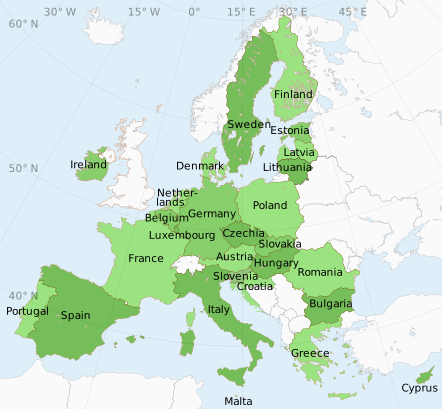
The European Union (EU) is a political and economic union comprising 27 member states, primarily located in Europe. These nations have voluntarily pooled…
Contents
- 🎵 Origins & History
- ⚙️ How It Works
- 📊 Key Facts & Numbers
- 👥 Key People & Organizations
- 🌍 Cultural Impact & Influence
- ⚡ Current State & Latest Developments
- 🤔 Controversies & Debates
- 🔮 Future Outlook & Predictions
- 💡 Practical Applications
- 📚 Related Topics & Deeper Reading
- Frequently Asked Questions
- References
- Related Topics
Overview
The genesis of the modern European Union lies in the ashes of World War II, driven by a desire for lasting peace and economic reconstruction. The foundational step was the [[european-coal-and-steel-community|European Coal and Steel Community (ECSC)]], established by the Treaty of Paris in 1951, uniting six nations: [[belgium|Belgium]], [[france|France]], [[germany|Germany]], [[italy|Italy]], [[luxembourg|Luxembourg]], and the [[netherlands|Netherlands]]. This was followed by the 1957 Treaties of Rome, creating the [[european-economic-community|European Economic Community (EEC)]] and the [[european-atomic-energy-community|European Atomic Energy Community (Euratom)]]. Over decades, through successive enlargements and treaty revisions, notably the [[maastricht-treaty|Maastricht Treaty]] in 1993 which formally established the European Union, membership expanded significantly. The most recent accession was [[croatia|Croatia]] in 2013, bringing the total to 27. The UK's departure in 2020, known as [[brexit|Brexit]], marked the first time a member state left the Union.
⚙️ How It Works
The EU operates through a complex institutional framework designed to manage shared sovereignty. The [[european-commission|European Commission]] proposes legislation and enforces EU law, while the [[european-parliament|European Parliament]] (directly elected by EU citizens) and the [[council-of-the-european-union|Council of the European Union]] (representing national governments) act as the primary legislative bodies. The [[european-council|European Council]] sets the EU's overall political direction and priorities. Decisions are made through various voting mechanisms, including unanimity for sensitive areas like foreign policy and taxation, and qualified majority voting for most other matters, ensuring that smaller states are not consistently outvoted by larger ones. The [[european-court-of-justice|European Court of Justice]] ensures EU law is interpreted and applied uniformly across all member states, with its rulings being legally binding.
📊 Key Facts & Numbers
As of 2024, the European Union comprises 27 member states, covering a land area of approximately 4.2 million square kilometers. The combined population stands at roughly 448 million people, representing about 5.8% of the global population. The EU's nominal GDP in 2023 was estimated at $17.9 trillion USD, making it one of the world's largest economic blocs. The Eurozone, comprising 20 of the 27 member states, uses the [[euro|Euro]] as its common currency, facilitating seamless trade and travel. The EU budget for 2024 is €189.6 billion, funded by member state contributions, customs duties, and other revenues, supporting various policies from agriculture to research and development.
👥 Key People & Organizations
Key figures and organizations are central to the EU's functioning. [[ursula-von-der-leyen|Ursula von der Leyen]] currently serves as the President of the [[european-commission|European Commission]], the executive arm. [[charles-michel|Charles Michel]] is the President of the [[european-council|European Council]], which brings together national leaders. The [[european-parliament|European Parliament]] is led by its President, currently [[roberta-metsola|Roberta Metsola]]. Beyond these institutions, influential bodies include the [[european-central-bank|European Central Bank]] (ECB), responsible for monetary policy in the Eurozone, and the [[european-investment-bank|European Investment Bank]] (EIB), which finances EU projects. National governments, led by their respective heads of state or government, play a crucial role in the [[council-of-the-european-union|Council of the European Union]].
🌍 Cultural Impact & Influence
The EU's influence permeates global culture and policy. Its commitment to human rights, democracy, and the rule of law has set international standards, particularly in areas like data privacy with the [[general-data-protection-regulation|General Data Protection Regulation (GDPR)]]. The free movement of people, goods, services, and capital within the Schengen Area has fostered unprecedented cultural exchange and tourism, with over 1.3 billion international tourist arrivals recorded in 2019 pre-pandemic. The [[euro|Euro]] has become the second most traded currency globally, impacting international finance. EU policies on environmental protection, such as ambitious climate targets, influence global sustainability efforts, often setting benchmarks for other regions like the [[united-states|United States]] and [[china|China]].
⚡ Current State & Latest Developments
The EU is currently navigating a complex geopolitical landscape, marked by the ongoing war in [[ukraine|Ukraine]] and its implications for energy security and defense cooperation. Discussions around further integration, particularly in defense and economic policy, are intensifying. The bloc is also grappling with internal challenges, including managing migration flows and addressing economic disparities between member states. The implementation of the [[european-green-deal|European Green Deal]], aiming for climate neutrality by 2050, remains a top priority, driving significant investment in renewable energy and sustainable technologies. Digital sovereignty and the regulation of large tech companies, exemplified by the [[digital-services-act|Digital Services Act]] and [[digital-markets-act|Digital Markets Act]], are also at the forefront of current policy debates.
🤔 Controversies & Debates
The very nature of shared sovereignty within the EU is a perpetual source of debate. Critics often point to a perceived democratic deficit, arguing that EU institutions are too distant from citizens and that national governments have ceded too much power. The principle of [[subsidiarity|subsidiarity]], which dictates that decisions should be taken at the lowest possible level of governance, is frequently invoked in discussions about the appropriate balance of power. Debates also rage over the economic policies, particularly within the Eurozone, with concerns about fiscal discipline and the burden of bailouts for struggling economies. Furthermore, the effectiveness and fairness of the EU's enlargement process, as well as its approach to foreign policy and security, are subjects of ongoing contention among member states and external observers.
🔮 Future Outlook & Predictions
The future trajectory of the EU hinges on its ability to adapt to global shifts. Potential areas for deeper integration include defense cooperation, particularly in response to increased geopolitical instability, and a more unified approach to energy policy to reduce reliance on external suppliers. The ongoing digital transformation presents both opportunities and challenges, with the EU aiming to become a leader in ethical AI and digital regulation. The prospect of further enlargement, with countries like [[western-balkans|those in the Western Balkans]] and [[ukraine|Ukraine]] aspiring to membership, will likely reshape the Union's internal dynamics and external relations. The success of the [[european-green-deal|European Green Deal]] will be a critical determinant of the EU's long-term economic and environmental sustainability, potentially influencing global climate action for decades to come.
💡 Practical Applications
The EU's existence has profound practical implications for its citizens and businesses. The [[single-market|Single Market]] allows for the free movement of goods, services, capital, and people, simplifying cross-border trade and employment opportunities. The [[euro|Euro]] eliminates currency exchange costs for businesses and travelers within the Eurozone. EU standards in areas like product safety, environmental protection, and consumer rights are widely adopted, ensuring a high level of protection for citizens across member states. Furthermore, EU funding programs, such as [[horizon-europe|Horizon Europe]] for research and innovation and [[erasmus-programme|Erasmus+]] for education and youth exchanges, provide significant opportunities for individuals and institutions.
Key Facts
- Year
- 1951-present
- Origin
- Europe
- Category
- politics
- Type
- organization
Frequently Asked Questions
How many member states are currently in the European Union?
As of 2024, there are 27 member states in the European Union. These nations have voluntarily agreed to share sovereignty through EU institutions. The most recent member to join was [[croatia|Croatia]] in 2013, while the [[united-kingdom|United Kingdom]] departed in 2020 following the [[brexit|Brexit]] referendum.
What is the primary purpose of the European Union?
The primary purpose of the European Union is to promote peace, democracy, and economic prosperity across Europe through cooperation and shared governance. It aims to create a single market for the free movement of goods, services, capital, and people, while also addressing common challenges like climate change, security, and digital transformation through unified policies and legislation.
How does EU law work in relation to national laws?
EU law takes precedence over national laws in areas where member states have transferred competence to the EU. This principle of supremacy, established by the [[european-court-of-justice|European Court of Justice]], means that national courts must apply EU law, and in cases of conflict, EU law prevails. This ensures a uniform application of EU regulations and directives across all 27 member states, from [[malta|Malta]] to [[sweden|Sweden]].
What are the main institutions of the European Union?
The main institutions of the European Union are the [[european-parliament|European Parliament]], which represents EU citizens; the [[council-of-the-european-union|Council of the European Union]], representing national governments; the [[european-commission|European Commission]], which proposes legislation and enforces EU law; and the [[european-council|European Council]], which sets the overall political direction. The [[european-court-of-justice|European Court of Justice]] ensures uniform interpretation and application of EU law.
What is the Schengen Area and how does it relate to EU membership?
The Schengen Area is a zone comprising 27 European countries that have abolished internal border controls, allowing for free movement of people. While most EU member states are part of the Schengen Area, it also includes some non-EU countries like [[norway|Norway]] and [[switzerland|Switzerland]]. Conversely, not all EU members are currently in Schengen, such as [[ireland|Ireland]] (which maintains its own border policies) and [[bulgaria|Bulgaria]] and [[romania|Romania]] (which are partially integrated).
How does one become a member state of the European Union?
Becoming a member state of the European Union involves a rigorous process of accession, requiring candidate countries to meet strict political, economic, and legal criteria known as the [[copenhagen-criteria|Copenhagen criteria]]. These include stability of institutions guaranteeing democracy, the rule of law, human rights, and respect for and protection of minorities; a functioning market economy capable of coping with competitive pressure within the Union; and the ability to take on the obligations of membership, including adherence to the objectives of political, economic, and monetary union. The process involves negotiations, legislative alignment, and ratification by all existing member states.
What are the economic benefits of being an EU member state?
Membership in the European Union offers significant economic benefits, primarily through access to the [[single-market|EU Single Market]], which allows for the frictionless movement of goods, services, capital, and people. This facilitates trade, attracts foreign investment, and promotes competition, leading to lower prices and greater choice for consumers. For countries in the [[eurozone|Eurozone]], the [[euro|Euro]] currency eliminates exchange rate risks and transaction costs, further boosting economic integration and stability. EU funding programs also provide substantial financial support for development, research, and infrastructure projects across member states.