White Sugar | Vibepedia
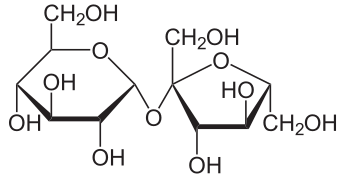
White sugar, chemically known as sucrose, is the highly refined crystalline form of sugar. Its journey from ancient agricultural byproduct to a global…
Contents
Overview
The genesis of white sugar can be traced back to ancient India, where sugarcane was first cultivated and processed for its sweet juice. This knowledge gradually spread westward through trade routes, reaching Persia by the 6th century CE, where the term 'shakar' (sugar) originated. Arab traders played a crucial role in introducing sugarcane cultivation and sugar refining techniques to the Mediterranean region, including Sicily and Spain, during the Middle Ages. The advent of colonialism in the Americas, particularly by the Portuguese and Spanish in the 15th and 16th centuries, marked a pivotal moment. Sugarcane plantations, fueled by enslaved labor, proliferated in Brazil and the Caribbean, transforming sugar from a luxury spice into a mass-produced commodity. The development of more sophisticated refining processes in Europe, notably in the Netherlands in the 17th century, led to the production of the pure white, granulated sugar that defines the modern product. This evolution was driven by figures like Olivier de Serres, who experimented with sugar beet cultivation in France in the late 16th century, foreshadowing a key alternative source.
⚙️ How It Works
The transformation of sugarcane or sugar beet into white sugar is a multi-stage industrial process. For sugarcane, harvested stalks are crushed to extract juice, which is then clarified using lime to remove impurities. This juice is boiled to concentrate it into a syrup, which is subsequently cooled to allow sucrose crystals to form. This raw sugar, containing molasses, is then shipped to refineries. At the refinery, raw sugar crystals are washed and redissolved into a syrup. This syrup undergoes further purification through filtration, often using activated carbon or bone char (though vegan alternatives are increasingly common), to remove residual color and flavor compounds. The purified syrup is then concentrated under vacuum to induce controlled crystallization, yielding fine, uniform white sugar crystals. These crystals are then dried and screened to achieve specific grain sizes, ready for packaging and distribution by major producers like Tate & Lyle and AB Sugar.
📊 Key Facts & Numbers
The global sugar industry is colossal. Brazil consistently leads as the largest producer, followed by India and the European Union. The United States, for instance, consumes approximately 9 million metric tons of sugar annually, with a significant portion being high-fructose corn syrup, but refined white sugar remains dominant. The global sugar market is valued at over $60 billion USD. A single teaspoon (4 grams) of white sugar contains roughly 16 calories and 100% of its weight in carbohydrates, with no significant vitamins or minerals. The average American consumes about 17 teaspoons (68 grams) of added sugar per day, a figure that far exceeds recommendations from organizations like the World Health Organization.
👥 Key People & Organizations
While no single individual 'invented' white sugar, its refinement and industrialization involved numerous contributors. Early pioneers in sugarcane processing in India and Persia laid the groundwork. In Europe, figures like Olivier de Serres (1560-1619) experimented with sugar beet cultivation, a crucial precursor to its widespread use as a sugar source. The development of industrial refining processes in the 17th and 18th centuries was a collective effort, with Dutch and British entrepreneurs playing significant roles. Major modern players include multinational corporations such as Tereos, Südzucker AG, Wilmar International, and American Sugar Refining, Inc., which operate vast networks of farms, mills, and refineries globally. Organizations like the International Sugar Organization and national sugar associations, such as the American Sugar Alliance, play key roles in market regulation, policy advocacy, and industry promotion.
🌍 Cultural Impact & Influence
White sugar's cultural impact is profound and pervasive. It became a symbol of wealth and status in Europe during the Renaissance and Baroque periods, adorning aristocratic tables. Its widespread availability, driven by industrial production and colonial expansion, fundamentally altered global cuisines, enabling the creation of complex pastries, confectionery, and sweetened beverages that define modern food culture. The 'sweet tooth' itself is arguably a culturally conditioned phenomenon amplified by the ubiquity of sugar. In the 20th century, sugar became deeply embedded in processed foods, from breakfast cereals like Kellogg's Corn Flakes to soft drinks like Coca-Cola. Its influence extends to art, literature, and music, often symbolizing indulgence, pleasure, or even addiction. The development of the sugar cube in the mid-19th century by Jakub C. Kryštof Rad further popularized its domestic use, making it more convenient for home cooks and coffee drinkers.
⚡ Current State & Latest Developments
The global sugar market continues to be dynamic, influenced by agricultural yields, trade policies, and evolving consumer preferences. In 2024, concerns over supply chain stability and the impact of climate change on sugarcane and sugar beet crops are prominent. There's a growing trend towards sugar reduction in processed foods, driven by public health initiatives and consumer demand for healthier options. This has led to increased innovation in sugar substitutes and alternative sweeteners. Simultaneously, the biofuel industry, particularly in Brazil, competes with sugar production for sugarcane, creating complex market interdependencies. Major sugar-producing regions are also investing in more sustainable farming practices to mitigate environmental impacts, such as water usage and soil degradation, a trend championed by organizations like the Sustainable Agriculture Initiative Platform.
🤔 Controversies & Debates
The health implications of excessive white sugar consumption are a major point of contention. Critics, including many public health organizations, link high sugar intake to a cascade of health issues: obesity, type 2 diabetes, heart disease, and dental cavities. The World Health Organization recommends limiting added sugar intake to less than 10% of total daily calories, and ideally less than 5%. Conversely, the sugar industry, through groups like the International Sugar Organization, often emphasizes sugar's role as a readily available energy source and disputes the direct causality of sugar alone for these chronic diseases, pointing to broader dietary patterns and lifestyle factors. Debates also arise regarding the environmental impact of large-scale sugarcane and sugar beet farming, including water usage, pesticide runoff, and land-use change, particularly in regions like the Amazon basin and parts of Eastern Europe. The historical legacy of slavery and indentured servitude in sugar production also remains a sensitive and critical aspect of its history.
🔮 Future Outlook & Predictions
The future of white sugar is likely to be shaped by a dual trajectory: continued widespread use in developing economies and a gradual decline or reformulation in developed markets. As global populations grow and incomes rise in regions like Africa and Southeast Asia, the demand for affordable sweeteners like white sugar is expected to increase. However, in North America and Europe, the push for sugar reduction will likely intensify, driving further innovation in low-calorie sweeteners, natural sweeteners, and sugar reformulation technologies. Advances in agricultural technology, such as CRISPR gene editing, may lead to more resilient and higher-yield sugar crops, potentially impacting global supply dynamics. The industry may also see increased pressure to adopt more sustainable and ethical production practices, addressing both environmental concerns and the historical exploitation associated with sugar cultivation.
💡 Practical Applications
White sugar's primary application is as a sweetener and texturizer in a vast array of food and beverage products. It is a fundamental ingredient in baking, providing sweetness, browning, and structure to cakes, cookies, and breads. In beverages, it is used to balance acidity and enhance flavor in everything from coffee and tea to sodas and fruit jui
Key Facts
- Category
- culture
- Type
- topic